Pods Are the New Silos: Why Marketing Reorgs Fail Without a Shared Data Foundation
Most marketing reorgs into pods will fail for the same reason, and it isn’t the people.
Separate teams for content, demand gen, design and analytics made sense when execution was the bottleneck. Every asset needed hands, so you hired specialists and lined them up in sequence.
AI changed that. Execution is no longer the main constraint.
The handoffs are.
A brief goes from demand gen to content to design to ops to analytics. Each team waits on the last one. By the time results come back, the moment has passed.
Budgets aren’t growing to cover the friction either. Most leaders are choosing tools over headcount, which puts the pressure on how the work is organized rather than how many people do it.
What a pod looks like
That is why better teams are organizing around outcomes instead of functions. Small pods own one result end to end: net-new pipeline, install base growth, category presence.
Content, product marketing and campaign roles sit together against the same goal, while ops, analytics and brand stay as shared teams that serve every pod.
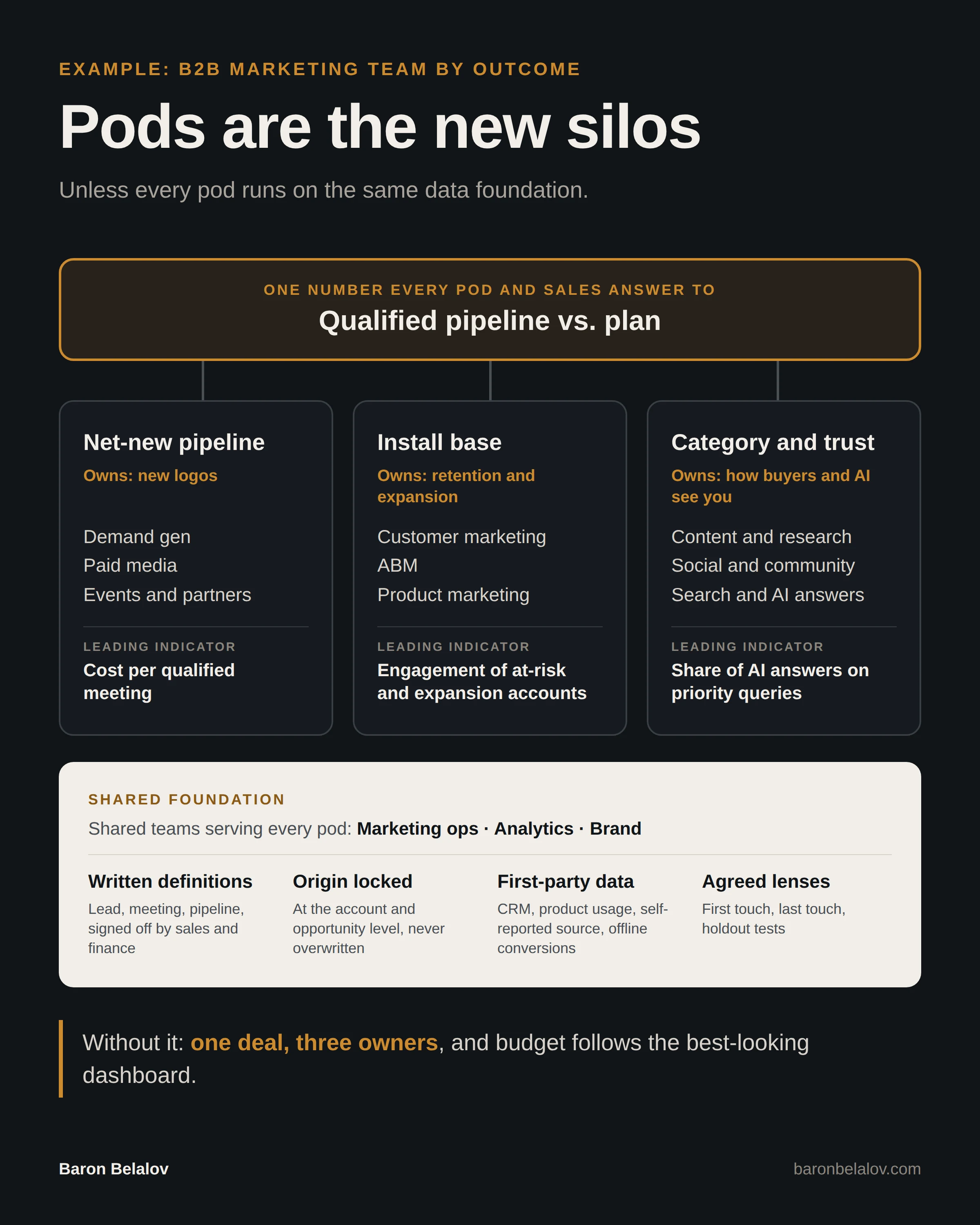
| Pod | Owns | Typical skills inside it | Leading indicator it controls |
|---|---|---|---|
| Net-new pipeline | New logos | Demand gen, paid media, events and partners | Cost per qualified meeting |
| Install base | Retention and expansion | Customer marketing, ABM, product marketing | Engagement of at-risk and expansion accounts |
| Category and trust | How buyers and AI see you | Content and research, social and community, search and AI answers | Share of AI answers on priority queries |
Fewer handoffs. Faster loops. More time spent on judgment rather than production.
It only works if people can span more than one lane
Pods change who you need.
A T-shaped paid specialist who reads a pipeline report and rewrites the brief when meetings stop converting. A product marketer who turns one launch message into twenty channel variations and knows which three need a human edit. A content lead who decides what to publish based on what buyers are already asking sales and customer success.
Deep in one thing, conversant in the rest.
Pure generalists struggle, because a pod still needs real expertise in each seat. Pure specialists who cannot work across data, tools and commercial metrics become the new bottleneck, because the pod waits on them the same way the old teams waited on each other.
A useful hiring question: “Walk me through a decision you made using data from outside your specialty.” T-shaped people have a ready answer. It is the same principle as screening for evidence rather than polish.
Then comes the part most reorgs skip: the data
In a recent restructure I led, the reporting broke before the org chart did.
Give three pods their own goals and their own dashboards, and you get three versions of the truth.
- The demand pod claims the deal because the lead came from a webinar.
- The install-base pod claims it because the company was already a customer.
- The content pod claims it because the champion read the research report.
Same deal, three owners. Each pod’s dashboard looks healthy. Budget follows whoever has the best-looking report, not whoever created the pipeline.
There is a quick way to check this on any team. Add up the pipeline each pod reports. If the total is larger than the pipeline in the CRM, the problem is already there.
Pods don’t need one attribution model
The usual fix is to pick one model and make everyone use it. That misses the point. Attribution is a set of lenses, and each one answers a different question. What pods need in common is one source of truth and a few agreed lenses:
- One definition of a lead, a meeting and pipeline, signed off by sales and finance.
- Every touch captured the same way, with origin locked at the account and opportunity level so later campaigns and system syncs cannot overwrite it.
- First touch to see what creates demand.
- Last touch to see what converts.
- Holdout tests to see what you would actually lose without a channel.
Blended models are fine for showing the ship is moving. They let every team claim a slice. They rarely tell you where the next dollar should go, which is why measuring the blend is a check on direction rather than a budgeting tool.
Origin locking sounds like a technical detail. It is the difference between knowing what created your pipeline and knowing what touched it last.
First-party data is the only record you own
None of it works without first-party data.
Ad platforms grade their own homework. Each one reports the conversions it can see and claims credit for them. Privacy changes keep shrinking what they can see, so more of what they report is modeled rather than measured.
The record you actually own is narrower and more reliable: the CRM, product usage, what buyers tell you about how they found you, and the outcomes you feed back to the ad platforms as offline conversions so their algorithms optimize for pipeline instead of form fills.
That self-reported “How did you hear about us?” field is imperfect, and it still catches podcasts, word of mouth and AI answers that no tracking pixel will.
Third-party intent data is useful for ranking accounts. It is rented, not owned, so it should never replace the list above.
One scorecard for every pod
With the foundation in place, every pod answers to the same scorecard: one shared pipeline number, agreed with sales, plus one to three leading indicators each pod controls and reviews weekly.
The shared number stops pods from optimizing against each other. The leading indicators give each pod something it can move this week. Win rate, pipeline per marketing dollar, retention and expansion stay as quarterly lagging measures.
The order of operations
If you are planning a reorg, this is the sequence:
- Write down the definitions of a lead, a meeting and pipeline, and get sales and finance to agree.
- Fix capture: campaign naming, origin locking, the self-reported field and offline conversions.
- Agree which lens answers which decision.
- Set the shared scorecard and baselines.
- Then reorganize into pods.
Step 1 is the one most teams skip, and it is the one that decides whether sales and marketing are even arguing about the same word. The targets in step 4 should be divided down from the revenue number rather than set by instinct.
Most companies run this list backwards, starting with step 5. That is how you end up with three dashboards, one deal and an argument about who gets credit.
Skip the foundation, and you have just moved the silos closer together.
Frequently asked questions
What is a marketing pod?
A small, cross-functional team that owns one business outcome end to end, such as net-new pipeline or install base growth, instead of one function such as content or paid media.
What is a T-shaped marketer?
Someone with deep expertise in one area, such as performance, brand or product marketing, plus enough range to work across data, AI tools and commercial metrics. Deep in one thing, conversant in the rest.
Which attribution model should marketing pods use?
More than one. First touch shows what creates demand, last touch shows what converts, blended models show overall direction, and holdout tests show what you would actually lose without a channel. What pods must share is one set of definitions and one source of first-party data.
Why do marketing pods fail?
Usually because each pod gets its own goals and dashboards without shared definitions or data. Each pod claims the same deals, reported pipeline exceeds real pipeline, and budget follows the best-looking report.

Baron Belalov is a fractional CMO working with growth-stage and established companies globally.